Ah, the beauty of the web and
Google News; allowing ordinary, non-globe trotting individuals to absorb news from all over the world from the (relative) comfort of their own computer.
Through reading news from "worldly" sources, such as the
BBC (England), and
The Age (Australia), I have noticed that credit is often given to the countrymen of the particular news source ahead of a foreigner, especially when it serves their purpose (or "advances the story line," as some people say). While this may not always give the reader the most accurate information, the practice is understandable. It’s also entertaining.
The foremost example that comes to mind is the invention of the Internet. And no, I’m not referring to Al Gore.
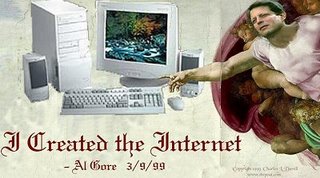
The invention of
Internet is commonly credited to Vint Cerf and his team of scientists at UCLA with their work on ARPANET in 1969. However, Dr. Leonard Kleinrock created the basic principles of packet switching, the technology underpinning the Internet, while a graduate student at MIT a decade earlier. The first TCP/IP wide area network was in use by 1 January 1983, when the National Science Foundation (NSF) constructed a backbone of university networks that would later become the NSFNet. Some people regard this as the actual invention of the Internet, not the sending of the first email in 1969 at UCLA.
Therefore, most references to the invention of the Internet, especially in America, mention Vint Cerf.
This is where it gets a little bit complicated. Contrary to popular belief, the Internet and the World Wide Web (notice how they are always capitalized) are not the same thing. The Internet is a collection of interconnected
computers, tied together with copper wires, glass fibers, and satellite connections; while the World Wide Web is a collection of interconnected
documents joined by hyperlinks and URLs that is accessible over the Internet.
The
World Wide Web was invented by Sir Tim Berners-Lee (a Briton) in 1989 at CERN in Switzerland after he constructed the precursor ENQUIRE in 1980. The World Wide Web became available to the public 6 August 1996 when he published the first ever "Web site" at http://info.cern.ch/, which apparently no longer exists. [Personally, I would think that they would have maintained that page as a kind of legacy, or something. But that’s just me.]
And as a result, when a European story is written about “the Web,” they refer to Tim Berners-Lee: "
When the web was invented in 1989 by Sir Tim Berners-Lee, nobody could have predicted the way it has pervaded all areas of life." (BBC)So, that ended up more as a weird history lesson then anything else, but I hope it was a little bit entertaining. The concept remains the same, news stories are written for a local audience, even when they are published world wide. On the Web. Over the Internet. And stuff.
**UPDATE: For those of you who care about what Al Gore actually did, you can go here:
http://www.snopes.com/quotes/internet.asp. (1:29 p.m.)